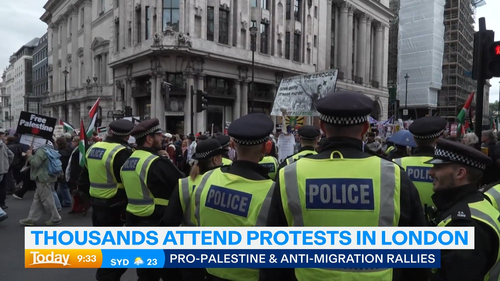
In what’s been described as a “significant public order policing operation,” London’s Metropolitan Police deployed at least 4000 officers, armoured vehicles, horses, dogs, drones and helicopters.
Most concerns focused on central London, where police sought to prevent any interaction between the two major demonstrations.
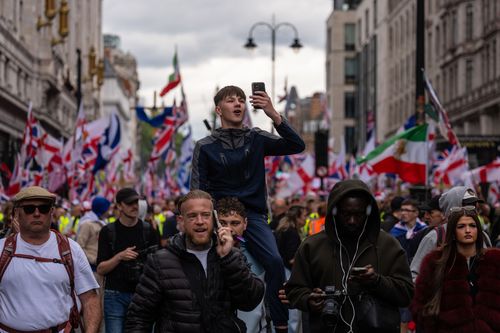
One march was organised by far-right activist Stephen Yaxley-Lennon, also known as Tommy Robinson.
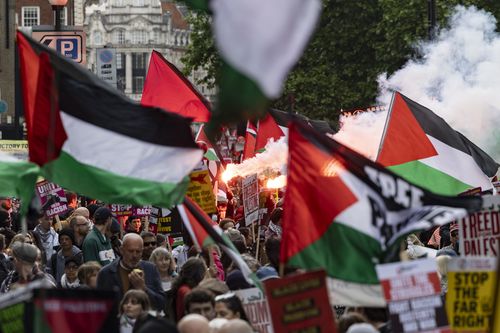
The other was the annual Nakba Day demonstration, which commemorates the 1948 exodus of around 700,000 Palestinians from what is now Israel.
Police remain on guard for any splinter groups coming into contact, and for any trouble following the conclusion of the FA Cup final, which was attended by more than 83,000 fans at Wembley Stadium.
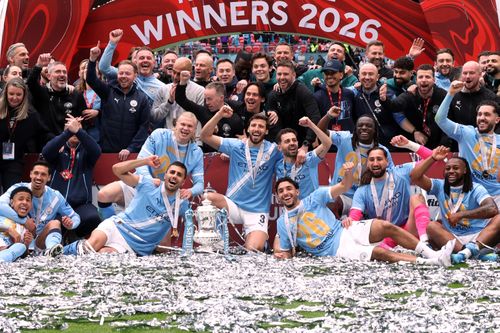
As of this morning, police said 43 people were arrested for a variety of offences. A further 22 were arrested at the FA Cup final, where Manchester City beat Chelsea.
Police said four officers were assaulted, none seriously, while a further six were subjected to hate crime offences.
The marches took place at a particularly radicalised time in British politics, with the extremes on the right and the left advancing across the UK in last week’s elections.
Protesters are driven by a range of grievances. Many are angry about the number of would-be asylum-seekers making the dangerous crossing across the English Channel from the French coast to the UK in small boats.
Others are protesting Israel’s actions in Gaza, which have devastated the Palestinian enclave and, according to the Gaza Health Ministry, killed more than 72,700 people.
Prosecutors have been told to consider whether protest placards, banners and chants viewed on social media may amount to offences of stirring up hatred during the rallies.
“This is not about restricting free speech,” said the Crown Prosecution Service’s director, Stephen Parkinson. “It is about preventing hate crime and protecting the public, particularly at a time of heightened tensions.”
The British government also blocked 11 foreign nationals from entering the country for the “Unite the Kingdom” rally.
Right-wing figures claiming to have been barred include Polish politician Dominik Tarczynski, Belgian politician Filip Dewinter, anti-Islam commentator Valentina Gomez and Dutch activist Eva Vlaardingerbroek.
“For anyone who sets out to wreak havoc on our streets, to intimidate or threaten anyone, you can expect to face the full force of the law.”
On Friday, Starmer visited the Metropolitan Police command centre to discuss policing arrangements for the rallies alongside Met Commissioner Mark Rowley and London Mayor Sadiq Khan.
Live facial recognition will be used for the first time in a protest policing operation.
Cameras have been set up in the north London neighbourhood of Camden, which is not on the route of the “Unite the Kingdom” march but is expected to be used by many people attending the event.