Tropical Storm Gabrielle continues to spin in the Atlantic and is expected to strengthen into a hurricane by the end of the weekend, according to the National Hurricane Center.
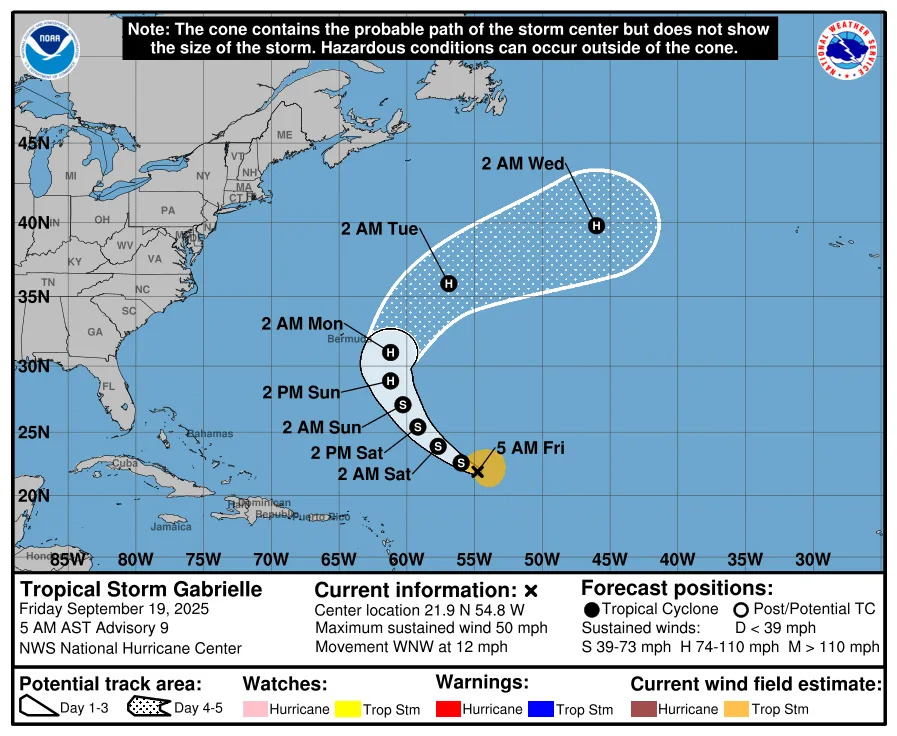
The hurricane center said in a Sept. 19 advisory that Gabrielle was located about 945 miles southeast of Bermuda with maximum sustained winds near 50 mph with higher gusts. Forecasters said “gradual strengthening” is expected, and Gabrielle is forecast to become a hurricane by Sunday, Sept. 21.
Gabrielle is moving toward the west-northwest at about 12 mph, with a gradual turn toward the northwest expected by Friday night, Sept. 19, followed by a north-northwestward turn by Saturday night, Sept. 20.
On the forecast track, the hurricane center said the center of Gabrielle is expected to pass east of Bermuda Sunday night and Monday, Sept. 22.

Forecasters said in the Sept. 19 advisory that swells generated by Gabrielle are expected to reach Bermuda and build through the weekend. These swells are likely to cause life-threatening surf and rip current conditions, according to the NHC.
The hurricane center is also tracking a tropical wave off the western coast of Africa that forecasters say could slowly develop through to middle to latter part of next week. For now, it has a 20% chance of formation through the next seven days.
More on Gabrielle: Tropical Storm Gabrielle forms in the Atlantic, ending ‘unprecedented’ storm drought
Tropical Storm Gabrielle tracker
This forecast track shows the most likely path of the center of the storm. It does not illustrate the full width of the storm or its impacts, and the center of the storm is likely to travel outside the cone up to 33% of the time.
Tropical Storm Gabrielle spaghetti models
Illustrations include an array of forecast tools and models, and not all are created equal. The hurricane center uses only the top four or five highest-performing models to help make its forecasts.
NHC also keeping an eye on 2 systems in the Pacific
Meanwhile in the Pacific, the hurricane center is keeping tabs on two systems that could both develop into tropical depressions in the coming days.
The first system, currently labeled as Invest 96L, is located a few hundred miles south-southwest of the southern tip of the Baja California peninsula. Forecasters said in a Sept. 19 advisory this system “does not have a well-defined surface circulation.”
However, a short-lived tropical depression could still form before the system encounters cooler sea surface temperatures and drier air, which will inhibit any further development, according to forecasters.
As for the second system, the hurricane center said a “large area of disorganized showers and thunderstorms” located a few hundred miles south of the southern coast of Mexico is associated with a trough of low pressure.
The NHC said environmental conditions appear conducive for some gradual development of this system, and a tropical depression could form by early to mid-next week as the system moves west-northwestward, roughly parallel to the coast of southern and southwestern Mexico.
How do hurricanes form?
Hurricanes are born in the tropics, above warm water. Clusters of thunderstorms can develop over the ocean when water temperatures exceed 80 degrees. If conditions are right, the clusters swirl into a storm known as a tropical wave or tropical depression.
A tropical depression becomes a named tropical storm once its sustained wind speeds reach 39 mph. When its winds reach 74 mph, the storm officially becomes a hurricane.
Prepare now for hurricanes
Delaying potentially lifesaving preparations could mean waiting until it’s too late. “Get your disaster supplies while the shelves are still stocked, and get that insurance checkup early, as flood insurance requires a 30-day waiting period,” the National Oceanic and Atmospheric Administration recommends.
-
Develop an evacuation plan. If you are at risk from hurricanes, you need an evacuation plan. Now is the time to begin planning where you would go and how you would get there.
-
Assemble disaster supplies. Whether you’re evacuating or sheltering in place, you’re going to need supplies not just to get through the storm but for a possibly lengthy aftermath, NOAA said.
-
Get an insurance checkup and document your possessions. Contact your insurance company or agent now and ask for an insurance checkup to make sure you have enough insurance to repair or even replace your home and belongings. Remember, home and renters insurance don’t cover flooding, so you’ll need a separate policy for those. Flood insurance is available through your company, agent or the National Flood Insurance Program.
-
Create a family communication plan. NOAA says you should take the time now to write down a hurricane plan and share it with your family. Determine family meeting places and make sure to include an out-of-town location in case of evacuation.
-
Strengthen your home. Now is the time to improve your home’s ability to withstand hurricanes. Trim trees and install storm shutters, accordion shutters and impact glass, and seal outside wall openings.