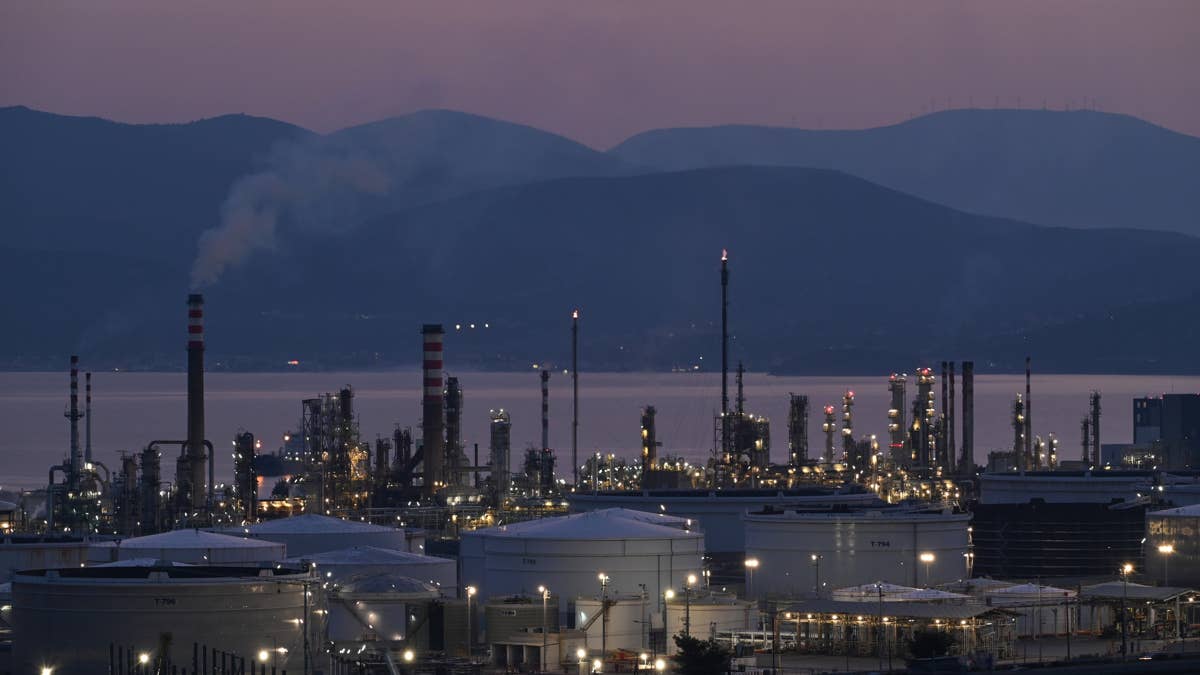
The U.S.-Iran conflict, now in its third month, has torn through global oil supply at a historic pace.
Yet prices at the pump, while painful, haven’t spiked as violently as past crises might suggest.
JPMorgan says it’s a warning sign that something far more unsettling is occurring beneath the surface.
For everyday Americans, the stakes couldn’t be more personal. Gas prices, grocery bills, and even airfares are all tied to what happens next.
Oil prices will impact consumer spending
To understand what JPMorgan (JPM) is flagging, it helps to know how oil markets work in a crisis.
When supply gets disrupted, there are essentially two pressure-relief valves. The first is spare production capacity, where other oil-producing countries ramp up output to cover the shortfall.
MoreEconomy:
- Ernst & Young drops stunning take on economy as oil jumps
- Treasure secretary delivers surprise take on the economy
- Powell sends message on U.S. economy and AI-related job loss fear
The second is global inventories, the strategic stockpiles nations hold for exactly these moments.
Both valves are now wide open, and the math still doesn’t work. According to JPMorgan global commodities strategy head Natasha Kaneva:
- Global supply disruptionsreached 13.7 million barrels per day (bpd) in April, roughly 14% of the world’s total demand.
- Spare capacity from Saudi Arabia and the United Arab Emirates is effectively offline due to closures of the Strait of Hormuz.
- So the world has leaned hard on inventories instead, drawing down a staggering 7.1 million bpd in April 2026.
- Even with that extraordinary drawdown, the market is still short by an estimated two million bpd.
Kaneva emphasized:
“Commodities markets are always forced into equilibrium: the market must clear. If production falls short of demand, the gap can’t persist.”
American drivers are feeling the heat
Here’s where things get personal.
When prices rise high enough and shortages deepen, people simply buy less oil. That’s demand destruction, and it’s already happening on a scale the world hasn’t seen since the 2008 financial crisis.
Global oil demanddropped by 4.3 million bpd in April. That’s nearly double the peak loss of demand recorded during the financial crisis, and it happened at price levels that don’t look extreme relative to historical highs.
According to a Yahoo Finance report, physical oil in some Asian markets has traded as high as $210 per barrel, while buyers in Sri Lanka reportedly paid close to $286 a barrel for near-term deliveries.
Most of that demand pain, about 87%, is concentrated in the Middle East, Asian frontier economies, and Africa, regions with thin financial buffers.
But the pressure is creeping toward Western consumers, too.
- U.S. regular gasoline averaged $4.05 per gallon as of late April, up sharply from roughly $2.88 before the war started.
- Higher pump prices are already reducing driving. Elevated airfares are starting to weigh on flight demand.
JPMorgan’s conclusion is pointed: American and European consumers may need to absorb more of the adjustment ahead.
- Goldman Sachs estimates Persian Gulf oil output is down roughly 57% from pre-war levels.
- Citi has warned that if flows through the Strait of Hormuz remain disrupted into June, Brent crude could hit $150 per barrel.
- JPMorgan’s own near-term warning puts the range at $120 to $130 a barrel, with $150-plus possible if the disruption drags into mid-May.
Inflation’s next move and what the Fed does about it
So what does all of this mean for the bigger economic picture?
JPMorgan has mapped three inflation scenarios, all hinging on one variable: how long the energy shock lasts.
- In the worst case, a re-escalation of conflict that pushes crude well above $120 a barrel through the summer could push headline consumer price index (CPI) inflation to top 5% and stay there.
- In the middle scenario, modeled on Russia’s 2022 invasion of Ukraine, inflation peaks near 4% before pulling back.
- Even in the most optimistic outcome, where diplomacy moves quickly and oil prices normalize gradually, CPI is likely to remain above 3% well into early 2027.
JPMorgan’s base case puts headline CPI at 4% by May. From there, falling oil prices, easing tariffs, and softer rent inflation could drag it back down toward 3% by December, and below 2% by April 2027.
The catch? In every scenario, inflation stays above the Federal Reserve’s 2% target through early next year.
Rate cuts remain off the table for now, and the Fed won’t move until the data gives it a clear reason to act.
For consumers already strained by higher gas prices and elevated borrowing costs, JPMorgan’s message is sobering: relief may be coming, but it won’t come quickly.