

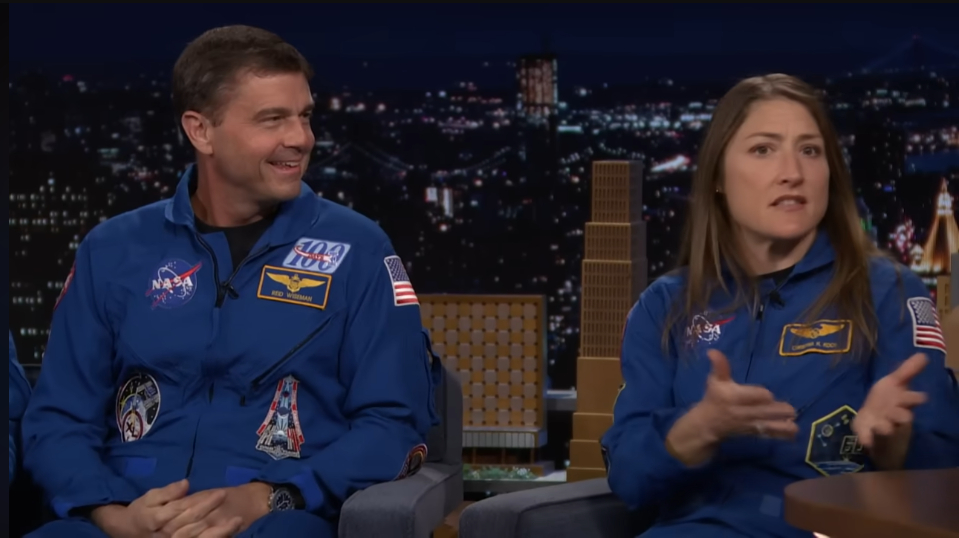
The excitement surrounding Artemis II isn’t just about returning humans to the Moon—it’s about rediscovering space through fresh human eyes. In a recent interview, the crew shared raw, personal insights that go far beyond the headlines. Their stories reveal a mix of awe, fear, humor, and deep human connection.

🚀 The Most Intense Moment Wasn’t Launch
When people imagine space travel, they often think the scariest part is liftoff. Surprisingly, the astronauts say that’s not true.
Launch, according to them, feels controlled—almost calm. But re-entry? That’s a completely different story.
As the spacecraft plunges back toward Earth at extreme speeds—around 6 miles per second (nearly 39 times the speed of sound)—the capsule becomes surrounded by blazing plasma. Flames engulf the windows, and the crew watches as they essentially ride inside a fireball.
It’s not just visual drama either. The heat is real, the pressure is intense, and every second feels critical. Returning home, it turns out, is far more violent than leaving.
🌍 “Tiny Earth” — A Perspective Shift Like No Other
One of the most powerful moments came not during high-speed maneuvers, but in quiet observation.
As the mission progressed, Earth slowly shrank in the distance. By day three, the crew had a nickname for it: “Tiny Earth.”
Looking out the window and seeing the entire planet reduced to a small glowing sphere changed everything. Everyday routines—eating, resting, preparing for sleep—would suddenly pause as astronauts caught sight of that distant blue dot.
It wasn’t just beautiful. It was emotional.
That view reinforced how fragile and unified our world truly is.
🌑 Witnessing the Moon’s Far Side
Seeing the far side of the Moon—often mistakenly called the “dark side”—was a defining moment.
The crew didn’t expect to experience it as early as they did. But as their trajectory shifted, they began noticing unfamiliar lunar terrain.
The reaction? Pure fascination.
They found themselves glued to the windows, realizing they were witnessing something very few humans have ever seen with their own eyes. It wasn’t just exploration—it was history unfolding in real time.
❤️ A Deeply Personal Tribute in Space
One of the most touching moments from the mission involved a spontaneous decision by the crew.
During their journey, they chose to name a lunar crater in honor of a crew member’s late wife. This wasn’t pre-planned—it emerged naturally from their bond as a team.
The tribute became even more meaningful because the astronaut’s children were watching from mission control, unaware it was coming.
It wasn’t just a symbolic gesture—it was a reminder that even in the vast emptiness of space, human emotions remain powerful and present.
🛰️ Life Inside the Orion Spacecraft
If you’re imagining a spacious, high-tech cabin, think again.
The Orion spacecraft is surprisingly compact—roughly comparable to the space inside a small vehicle.
The astronauts described it as constantly being within arm’s reach of one another. Privacy? Almost nonexistent.
For 10 days, they lived, worked, and moved in extremely tight quarters. Simple tasks required coordination, patience, and cooperation.
And yet, instead of tension, the experience strengthened their bond.
They didn’t just function as a team—they became a family.
😂 Humor in Zero Gravity
Despite the intensity of the mission, humor played a big role.
From floating food experiments to playful debates about who performed the best “space tricks,” the crew kept spirits high.
They even joked about everyday challenges—like adapting to basic routines in microgravity. These lighthearted moments helped balance the seriousness of their mission.
🤝 The Power of Teamwork
After years of training together, the crew expected to work well as a unit. But even they were surprised by how supportive they became of one another.
They described giving each other “grace”—being patient, understanding, and adaptable in a high-pressure environment.
That emotional intelligence turned out to be just as important as technical skill.
🌌 Final Thoughts: More Than Just a Mission
The Artemis II mission isn’t only about reaching the Moon—it’s about redefining how we experience space.
From the terror of re-entry to the quiet wonder of seeing Earth from afar, these astronauts didn’t just travel through space—they connected with it on a deeply human level.
Their journey reminds us that exploration isn’t just about distance. It’s about perspective, emotion, and the shared experience of pushing beyond what we thought was possible.